Filming in Ghana: The Complete Guide to Permits, Visas & Production Support
Written by Nicole Boshoff, Marketing Director, Atlas Film Fixers Last verified: August 6, 202
Quick Answer
Ghana doesn’t yet have a confirmed, operational cash rebate — a 20% tax rebate was announced back in 2024 but its rollout status remains unclear — though the country offers a growing production industry, diverse talent, and coastal, urban, and forest locations. Foreign crews need a Filming in Ghana Permit and Media Accreditation from the National Film Authority (NFA). Compared to Kenya’s faster KFCB turnaround, Ghana’s permit process runs longer and needs more lead time.
| Filming in Ghana at a glance | Detail |
| Film incentive/rebate | Announced 20% tax rebate (2024) — operational status unconfirmed; verify current status with NFA |
| Filming permit authority | National Film Authority (NFA) |
| Filming permit cost | ~$100 + $50 application fee (reported) — confirm current fee schedule with NFA |
| Filming permit processing | 5–15 days for straightforward shoots; allow 3–6 weeks for public spaces, heritage sites, or drone-inclusive shoots |
| Media/press accreditation | Mandatory for all crew — ~$200/person, 2–4 weeks |
| Visa requirement for filming in Ghana | Required in advance for most nationalities (UK, EU, US, Canada, Australia); visa-on-arrival not standard |
| Visa processing | 5–15 working days, depending on consulate |
| Work permit (paid filming) | Required separately from visitor visa; case-by-case fees and timing |
| ATA Carnet accepted for filming in Ghana | Not confirmed — equipment typically cleared via a temporary import permit instead |
| Drone authority filming in Ghana | Ghana Civil Aviation Authority (GCAA) — prior written approval mandatory for commercial use |
| Local crew target | NFA’s “Shoot in Ghana” campaign targets 80% Ghanaian crew on inward-investment productions |
Note: Ghana’s proposed film tax rebate was announced in 2024 alongside import duty exemptions, but no confirmed evidence shows it is fully operational as of mid-2026 — confirm directly with the National Film Authority before assuming it applies to your production.
Does Ghana Offer a Film Rebate?
Status unclear — verify before budgeting around it. In February 2024, then-President Nana Akufo-Addo announced plans for Ghana’s first film tax incentive: a 20% tax rebate for strategic film productions, alongside import duty exemptions on production equipment, port tax exemptions, and other financing reliefs, to be “elaborated by cabinet.” As of mid-2026, we could not confirm this incentive is fully implemented and operational for international productions — treat it as an announced policy direction rather than a confirmed, bookable rebate, and get current confirmation from the NFA directly before factoring it into a budget.
What Ghana offers reliably today: an active, government-supported film industry (the NFA runs the annual Africa Cinema Summit and a “Shoot in Ghana” campaign aimed at attracting inward investment), a growing pool of local crew and talent, and genuinely varied locations from Accra’s urban energy to coastal forts and forest regions.
Filming in Ghana: Film Permit Guidance
Issuing authority: the National Film Authority (NFA), established under Act 935 to regulate Ghana’s film ecosystem.
Two separate approvals are required:
1. Filming Permit — the general permit required before any filming activity, covering location, date, time, equipment, personnel, and any special effects, actions, or stunts involved.
2. Media/Press Accreditation — mandatory for every individual crew member, proving official approval to film in the country. This is separate from the Filming Permit itself.
Application requirements typically include:
- A synopsis of the project
- Shooting dates and locations
- A list of equipment
- Names of crew members
- Passport copies and passport-sized photographs (for accreditation)
Processing time: reported figures vary meaningfully by source and shoot complexity — some fixers cite 5–15 days for a standard filming permit, while others advise allowing a minimum of 3–6 weeks for shoots involving public spaces, government buildings, heritage sites, or drone use. Media accreditation typically takes 3–4 weeks, though this can sometimes be fast-tracked to around 2 weeks.
Cost: filming permit fees have been reported around $100 plus a $50 application fee, though Hoodlum-style sources describe location-dependent, case-by-case fee assessment — the safest approach is to confirm current pricing directly with the NFA or a local fixer before budgeting.
Local partner requirement: the NFA process is generally handled through a local fixer who submits the application on the production’s behalf, providing the synopsis, dates, equipment list, and crew names.
Location Permits & Special Approvals for filming in Ghana
Location permits are separate from the general Filming Permit and are required for filming in specific locations such as national parks, historical sites, government buildings, or private property (with owner permission).
Wildlife filming: productions filming in national parks or with animals need permission from Ghana’s parks and wildlife authority, and must follow a code of conduct — maintaining safe distance from animals, avoiding environmental damage, and not disturbing wildlife.
Different national parks carry different tariffs depending on the activity, so location-specific costs should be confirmed per site rather than assumed to follow a single national rate.
Visa Requirements
Ghana is not part of the Schengen Area, and its visa system operates independently:
- Most foreign nationals — including from the UK, EU member states, the US, Canada, and Australia — require a visa prior to arrival
- Visa-on-arrival is not standard practice and requires pre-approval in exceptional cases only — don’t plan around it as a fallback
- Visas must generally be obtained through a Ghanaian embassy or consulate before travel
- Processing time: typically 5–15 working days, depending on the consulate
- Visitor status does not permit paid work — filming and paid production activities require appropriate work authorization in addition to entry visas
- Work permits: foreign cast and crew undertaking paid filming activities need separate work permits and filming approval, assessed case-by-case
- Fees vary by nationality and processing speed
Because visa and work-permit processing can run several weeks, and the NFA filming permit process can take just as long, start both in parallel rather than sequentially wherever possible.
Drone Filming Regulations for filming in Ghana
Drone operations in Ghana are regulated by the Ghana Civil Aviation Authority (GCAA).
- Prior written authorization is mandatory for all commercial drone filming
- Restrictions apply near airports, military installations, government buildings, and densely populated urban areas
- Drone importation requires the correct documentation and paperwork, following proper procedure — plan this alongside your equipment import process rather than as an afterthought
- Operating without approval can result in equipment confiscation or penalties
Equipment Customs Clearance
Ghana’s ATA Carnet status is not clearly confirmed in current sources, so don’t assume Carnet coverage will apply. In practice, most productions clear equipment through a temporary import permit process instead:
- Submit a list of equipment with the declared value of each item
- A customs agent generates a temporary import permit, with an associated fee
- This is typically coordinated through a local fixer working with a customs agent, rather than handled independently
Ghana’s broader import framework also includes duty exemptions tied to Free Zones and specific investment incentives, but these generally apply to registered investment activity rather than standard temporary production equipment — don’t assume they apply to your shoot without direct confirmation.
Local Talent & Crew
Ghana has a diverse, active pool of skilled talent for film and television production. The NFA’s “Shoot in Ghana” campaign has specifically pushed to build local infrastructure and crew skills, with inward-investment productions targeted to employ around 80% of crew from Ghana — worth factoring into crew planning and budgeting from the outset, both as a practical local-hiring consideration and because it reflects the direction of government policy.
Country Overview
Main filming hub: Accra, the capital, offering urban settings alongside easy access to coastal and forest locations.
Language: English (official), with Twi, Ga, Ewe, and other local languages widely spoken.
Currency: Ghanaian Cedi (GHS).
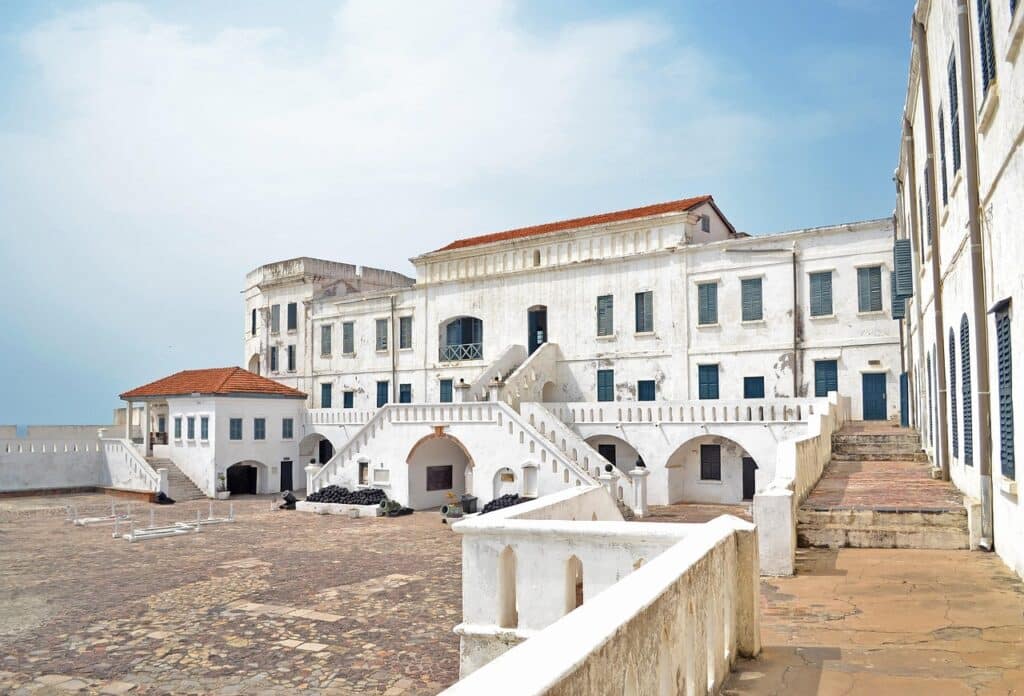
Ghana’s West African coastline, colonial-era forts, forested interior, and modernizing urban centers give productions meaningful range within a single country, alongside a film industry the government has actively worked to professionalize and internationalize in recent years.
Frequently Asked Questions
Does Ghana have a film tax rebate?
A 20% tax rebate was announced by the Ghanaian government in February 2024, alongside import duty exemptions for production equipment, but its operational status as of mid-2026 is unconfirmed. Verify current status directly with the National Film Authority before assuming it applies to your production.
What permits do I need for filming in Ghana?
Two separate approvals: a general Filming Permit covering your production plan and locations, and Media/Press Accreditation, which is mandatory for every individual crew member.
How long does it take to get a film permit in Ghana?
Reported timelines vary — some sources cite 5–15 days for straightforward shoots, while others recommend allowing 3–6 weeks for shoots involving public spaces, heritage sites, government buildings, or drone work.
Do I need a visa to film in Ghana?
Yes, for most nationalities, including the UK, EU, US, Canada, and Australia. Visas must generally be obtained in advance through a Ghanaian embassy or consulate — visa-on-arrival isn’t standard. Paid filming work additionally requires a separate work permit.
Does Ghana accept ATA Carnets for film equipment?
This isn’t clearly confirmed. Most productions instead clear equipment through a temporary import permit process arranged by a customs agent, based on a declared equipment list and value.
Do I need a permit to fly a drone in Ghana?
Yes. The Ghana Civil Aviation Authority requires prior written authorization for all commercial drone filming, with restrictions near airports, military sites, government buildings, and dense urban areas.
Is there a local crew requirement for filming in Ghana?
There’s no confirmed hard legal quota, but the NFA’s “Shoot in Ghana” campaign targets around 80% Ghanaian crew employment on inward-investment productions — worth planning around given the direction of government policy.
Key Official & Reference Links
- National Film Authority (NFA) — Ghana
- Ghana Civil Aviation Authority (GCAA)
- Ghana Revenue Authority (GRA) — Customs
Figures in this guide (permit fees, processing times, rebate status) reflect the most current publicly available information as of mid-2026, but Ghana’s film incentive framework, permit fees, and visa/work permit processes are subject to change, and reported figures vary meaningfully across sources. Always confirm current requirements directly with the National Film Authority, the relevant Ghanaian embassy, or a local production services partner before finalizing a production budget or schedule. This guide is for informational purposes and isn’t a substitute for official government guidance or legal/immigration advice.
Why Choose Atlas Film Fixers for Filming in Ghana?
Navigating Ghana’s evolving film landscape — and its still-unconfirmed incentive rollout — requires local knowledge and up-to-date relationships. Atlas Film Fixers provides end-to-end production support to keep your project on schedule:
- Permit Procurement — managing NFA filming permit and media accreditation applications, plus location-specific approvals
- Visa & Work Permit Support — coordinating entry visas and work authorization alongside your filming permit timeline
- Location Scouting — identifying Ghana’s coastal, urban, and forest locations, and securing wildlife/national park permissions where needed
- Logistics & Compliance — managing equipment customs clearance, drone authorization, and crew/vendor coordination
- Local Partnerships — connecting your production with Ghanaian crew and talent, supporting local-hiring goals and smoother on-the-ground execution
For expert guidance and seamless logistics, contact Atlas Film Fixers to ensure your production benefits from Ghana’s unique offerings while adhering to local regulations and maximizing efficiency.
Sources & Last Verified
This guide was last verified on August 6, 2026 against the following sources:
- National Film Authority (nfa.gov.gh) — permit process and structure
- Ghana government incentive announcement (February 2024, via Screen Daily/Deadline reporting) — proposed tax rebate status
- Multiple West Africa production-services fixer resources — permit costs, accreditation, drone, and customs process cross-checked for consistency
- Ghana Revenue Authority — customs and import procedures
Fees, processing times, and incentive status are subject to change without notice by Ghanaian authorities, and reported figures vary across sources — this guide flags that variance rather than presenting a single unconfirmed number as fact. If you find information that no longer matches official sources, contact us and we’ll update it.