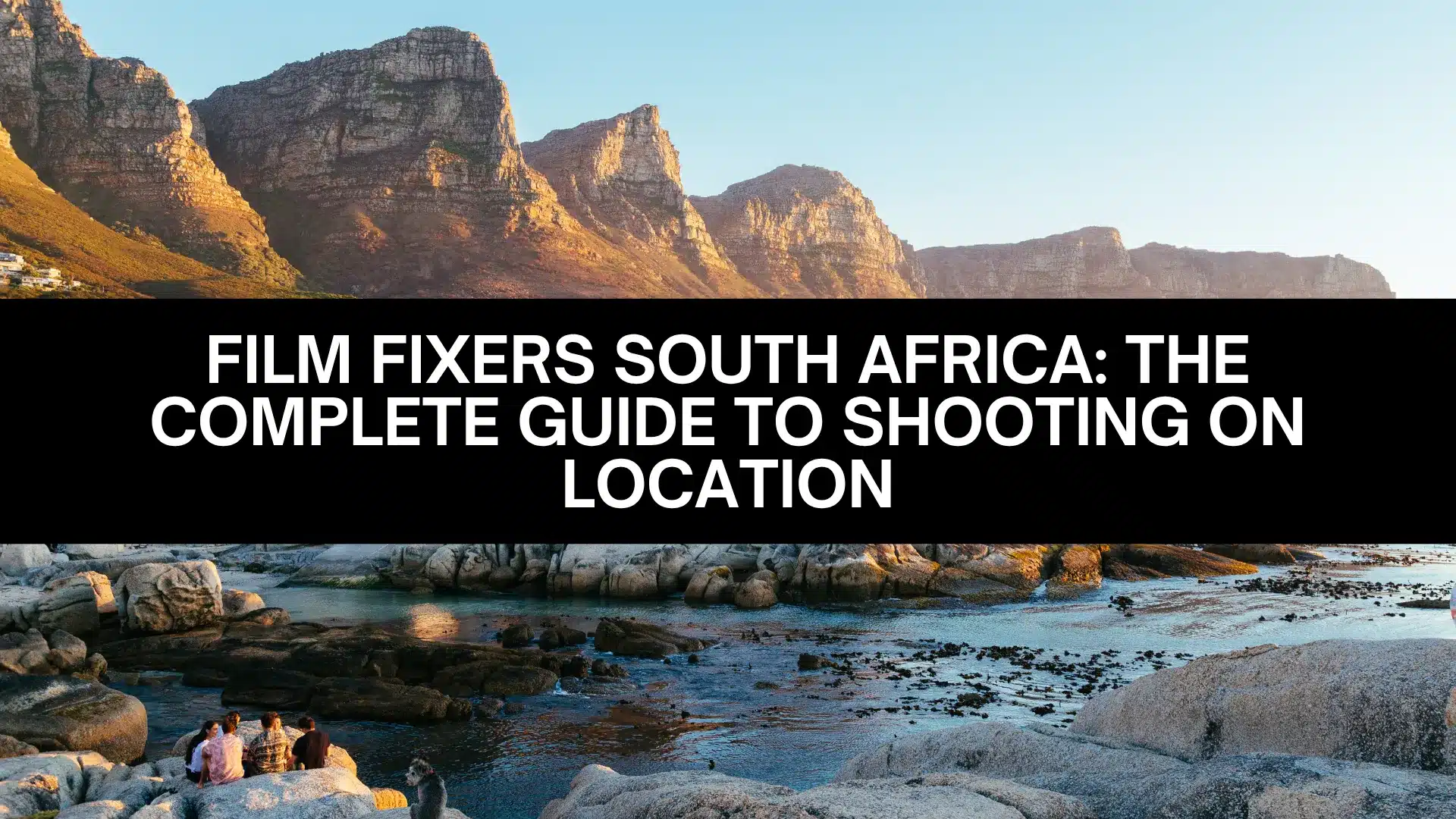
Filming in South Africa: The Complete Guide to the Film Incentive, Permits & Production Support
Written by Nicole Boshoff, Marketing Director, Atlas Film Fixers Last verified: August 21, 2026
Quick Answer
South Africa’s Foreign Film and Television Production Incentive normally offers 25% of local spend back, but the programme has been effectively frozen since March 2024 — no new project approvals for over two years, amid a government payment backlog. A restart agreement was reached in mid-August 2026, with backlog processing due to resume September 30, 2026 and new applications expected to be adjudicated from November 2026. Beyond the incentive, South Africa offers Cape Town, Johannesburg, and Durban’s deep production infrastructure and experienced crews. Confirm current DTIC operational status before budgeting around the rebate.
| Filming in South Africa at a glance | Detail |
| Foreign Film Incentive rate | 25% of Qualifying South African Production Expenditure (QSAPE), up to 30% with bonuses |
| Administered by | Department of Trade, Industry and Competition (DTIC) |
| Incentive cap | R25 million per project |
| Incentive status (as of Aug 2026) | Frozen for new approvals since March 2024 — restart agreed, backlog resolution due Sept 30, 2026, new adjudications expected from Nov 2026 |
| Minimum spend | R1.5 million (general); R500,000 for documentaries |
| International crew accreditation | FIVA letter (Film Industry Visa Assistance) |
| FIVA processing | 48 hours |
| FIVA fee | R690 |
| Film permit authorities | Municipal — City of Cape Town, Gauteng Film Commission (Johannesburg), Durban Film Office |
| Film permit processing | ~7 working days |
| ATA Carnet accepted | Yes — required, obtained in country of origin |
| Drone permit processing | ~5 working days |
Note: South Africa’s DTIC film incentive situation is actively developing as of publication. Given the extended freeze and recent restart agreement, always confirm current application status directly with the DTIC or a local production partner before budgeting around the rebate.
Important 2026 Update: The DTIC Film Incentive Freeze
This is essential reading before planning a South Africa shoot around the rebate. South Africa’s Foreign Film and Television Production and Post-Production Incentive — administered by the DTIC and one of the country’s most effective tools for attracting international productions since its introduction around 2004 — has been in serious operational crisis.
What happened: the DTIC’s adjudication committee, responsible for approving new incentive applications, last met in March 2024. No new productions were approved during the 2024/25 or 2025/26 financial years. The root cause traces back to COVID-era budget reallocation, which created a “contingent liability” — a backlog of unpaid commitments to already-approved productions — that peaked at roughly R2 billion in the year ending March 2021.
Industry impact: the Save SA Film and TV Jobs Coalition — representing producers, actors, writers, directors, editors, cinematographers, and other crew — reported that Cape Town’s film industry alone shed jobs from 4,943 full-time-equivalent positions in 2021 to just 884 in 2024. The coalition estimated 1,850 jobs and R822 million in production spending were lost in a single recent financial year, with roughly R700 million in stalled production applications caught in the backlog. Hundreds of industry workers protested in Cape Town in January 2026.
Where things stand now: after sustained pressure and parliamentary intervention, the DTIC and the Save SA Film and TV Jobs Coalition reached a three-month action plan in mid-August 2026. Under the agreement:
- The outstanding payment backlog (reduced from R2 billion to roughly R255–473 million by mid-2026) is due to be resolved, with processing set to resume around September 30, 2026
- New incentive applications are expected to begin adjudication from November 2026
- The agreement includes roughly R2 billion in incentive allocations committed across the current and next two financial years
What this means for your production: if you’re planning a shoot in South Africa with the incentive factored into your budget, confirm the current, live status directly with the DTIC or your local production partner before finalizing financials — this situation has been fluid for over two years and the November 2026 restart, while agreed, has not yet been tested in practice at the time of writing.
The Foreign Film and Television Production Incentive: How It Works (When Operational)
Rebate rate: 25% of Qualifying South African Production Expenditure (QSAPE) for productions shooting on location in South Africa.
Bonus tiers:
- An additional 5% for productions that both shoot and conduct post-production in South Africa using a black-owned service company
- An additional 2.5% of Qualifying South African Post-Production Expenditure (QSAPPE) for spending at least R10 million of post-production budget in South Africa
- An additional 5% for spending at least R15 million of post-production budget in South Africa
- Combined, these bonuses can bring the effective rate toward 30% for qualifying productions
Cap: the incentive is capped at R25 million per project.
Minimum spend: R1.5 million QSAPE for standard qualifying formats; R500,000 for documentaries.
Key eligibility requirements:
- At least 14 calendar days and 60% of principal photography must be filmed in South Africa (this may be waived for productions with a minimum QSAPE of R50 million)
- At least 75% of the total production budget must be QSAPE
- Applicants must procure a minimum of 20% of qualifying goods and services from entities that are at least 51% black-owned by South African citizens, operating for at least one year
- Application timing is critical: the application must be submitted before the project commences anywhere in the world, not just before South African filming begins
- Where the project isn’t fully funded at application, at least 80% of the total production budget must be secured, with 100% required before principal photography begins
- The Special Purpose Corporate Vehicle (SPCV) used for the South African leg must meet B-BBEE contributor status requirements
Given the current freeze described above, treat these terms as the programme’s designed structure — confirm which of these requirements remain in active effect once new adjudications resume.
Country Overview
Main cities: Cape Town, Johannesburg, Port Elizabeth, and Durban.
Languages: English, Afrikaans, Sotho, Xhosa, and Zulu.
Currency: South African Rand (ZAR).
Climate: South Africa has a subtropical climate, moderated by its oceanic borders on three sides and an elevated interior plateau — creating warm, filming-friendly conditions across much of the country.
Visa Requirements
- Check exemption status: confirm whether your nationality is visa-exempt or requires a visa via the South African Department of Home Affairs’ exempt countries list
- Required documents: a valid passport with 2 blank pages (valid at least 30 days after departure), flight itinerary, proof of accommodation, and a FIVA letter (see below)
- Processing: visa applications themselves are the traveling crew member’s own responsibility — Atlas Film Fixers assists with the FIVA letter and accreditation side of the process, not the visa application itself
- Vaccination: a Yellow Fever vaccination card is required for travelers from certain nationalities/regions — confirm requirements for each crew member’s travel history
International Crew Accreditation (FIVA Letter)
Foreign crew members require a FIVA letter (Film Industry Visa Assistance), applied for by a registered production company — such as Atlas Film Fixers — on the production’s behalf, to facilitate a smooth filming experience in South Africa.
Application requirements:
- Copy of the data page of the crew member’s passport
- Home address of the crew member traveling
- Designation (job title)
Processing time: 48 hours.
Application fee: R690 (ZAR).
General Film Permit
Permitting authorities are municipal, not national — there is no single blanket permit covering the whole country:
- Cape Town: City of Cape Town
- Johannesburg: Gauteng Film Commission
- Durban: Durban Film Office
Processing time: approximately 7 working days, depending on the specific job requirements.
Application requirements: submitted under the care of your local production partner (Atlas Film Fixers manages this process on your behalf).
Permit costs: vary depending on the specific job requirements — confirm current fees for your specific municipality and production type.
Drone Permit
Regulations: maintain a safe distance from airports and government institutions.
Importation: drones are permitted for importation, making it straightforward to bring your own equipment into the country.
Permitting authority: the relevant permitting office issues drone permits.
Application requirements: submitted under the care of your local production partner.
Processing time: allow 5 working days for permit processing.
Permit costs: vary — request a quotation for detailed pricing based on your specific shoot.
Equipment Customs Clearance
Carnet requirements: an ATA Carnet is required and must be obtained in the country of origin before departure.
Process: the Carnet must be fully completed in the country of origin, listing all equipment, serial numbers, and values.
Issuing organization: South African Customs is responsible for issuing equipment customs clearance based on the presented Carnet.
Safety & Security
Ensuring the safety and security of your crew, cast, and equipment is a key part of planning a South Africa shoot. Tailored security solutions are available, including:
- Security guards — trained, experienced personnel to safeguard equipment, crew, and locations
- Security needs vary by city and specific location, so a location-by-location risk assessment as part of pre-production is recommended
Frequently Asked Questions
Is South Africa’s film incentive currently operational?
It’s in a state of active recovery. The DTIC’s adjudication committee, which approves new incentive applications, hasn’t met since March 2024 due to a government payment backlog. A restart agreement was reached in August 2026, with backlog resolution expected by September 30, 2026, and new applications expected to be adjudicated from November 2026. Confirm current status directly with the DTIC before budgeting around it.
What is the South Africa film incentive rate when operational?
25% of Qualifying South African Production Expenditure (QSAPE), rising to as much as 30% with bonuses for using a black-owned service company and higher post-production spend thresholds, capped at R25 million per project.
What’s the minimum spend to qualify?
R1.5 million QSAPE for standard formats, or R500,000 for documentaries.
What is a FIVA letter?
Film Industry Visa Assistance — a letter required for foreign crew members, applied for by a registered production company on the production’s behalf, taking 48 hours to process at a cost of R690.
Who issues film permits in South Africa?
Permits are issued at the municipal level, not nationally: the City of Cape Town, the Gauteng Film Commission for Johannesburg, and the Durban Film Office for Durban.
Does South Africa accept ATA Carnets for film equipment?
Yes, and it’s required. The Carnet must be obtained and fully completed in your country of origin before departure.
How long does it take to get a drone permit in South Africa?
Allow approximately 5 working days for processing.
When should I apply for South Africa’s Foreign Film Incentive?
Before your project commences anywhere in the world, not just before South African filming begins — this is a strict requirement of the programme’s design.
Key Official & Reference Links
- DTIC — South African Film and Television Production Incentive
- DTIC — Foreign Film and Television Production and Post-Production Incentive
- South African Department of Home Affairs — Visa Exempt Countries
- National Film and Video Foundation (NFVF) — Incentives
Figures in this guide (incentive rates, caps, processing times) reflect the most current publicly available information as of mid-2026, but South Africa’s film incentive programme is in an active, fluid recovery process following a two-and-a-half-year adjudication freeze. Always confirm current requirements and live operational status directly with the DTIC or a local production services partner before finalizing a production budget. This guide is for informational purposes and isn’t a substitute for official government guidance or legal/immigration advice.
Contact Atlas Film Fixers
For expert guidance and seamless logistics, contact Atlas Film Fixers to ensure your production benefits from the unique offerings of this spectacular location while adhering to local regulations and maximizing efficiency:
- Incentive Guidance — helping you understand the current, live status of the DTIC incentive and structure your application accordingly
- FIVA Letter & Crew Accreditation — managing the Film Industry Visa Assistance process for your full international crew
- Permit Procurement — coordinating municipal film permits across Cape Town, Johannesburg, and Durban
- Location Scouting — identifying the right settings across South Africa’s diverse cities and landscapes
- Logistics & Compliance — managing ATA Carnet customs clearance, drone permits, and on-set security
Take a look at our Instagram for more updates on incentives and productions.
Sources & Last Verified
This guide was last verified on August 21, 2026 against the following sources:
- Department of Trade, Industry and Competition (DTIC) — official incentive guidelines, rates, and caps
- Multiple South African news sources (August 2026) — AllAfrica, TimesLive, GroundUp, IOL, 2oceansvibe — reporting on the DTIC adjudication freeze and the mid-August 2026 restart agreement
- National Film and Video Foundation (NFVF) — incentive programme structure
Given the fast-moving nature of the DTIC incentive situation, this section in particular should be reconfirmed close to any actual production date rather than relied upon as a static fact. If you find information that no longer matches current status, contact us and we’ll update it.